
All Things Don't Have to Be Equal!
New Research Provides Alternative to Settling


You've likely seen the oft-shared statistic about aging: We lose 1% of our muscle mass per year after the age of 40, all things being equal. That sounds depressing for anyone entering or moving through the 2nd half of life. 1% per year converts to a life-altering 10% a decade - yikes! But wait a minute - what if the most important part of that statement isn't the 1%/year reference but rather the "all things being equal" qualifier?
Ceteris paribus is Latin for this qualifier. It is utilized in economics, epidemiology and a range of scientific modeling scenarios. The fact that all things don't have to be equal is the essence of our Not Done Yet! approach to living. It's a reminder that while age certainly is a factor to our physiological changes, we are NOT forced to follow the population trends on which the majority of the data is based. "All things being equal" indicates we're settling for the status quo. If you've tapped into the resources here, that's not you. Now, thanks to the intriguing research of Yale University's Dr. Ray C. Fair, you have an data-driven way in which you can show the positive impact of your refusal to allow ceteris paribus to run your life.
Dr. Fair has been studying the effects of aging on athletic performance for years. His September 2024 study analyzed world record performances for each year from age 30 onward. He collected and reviewed data for both women and men in swimming, rowing, and, most notable for many of our readers here, running. The use of world records eliminated the historical problem of survivor bias, as weaker subjects drop out from a sample. This, in turn, over represents those with greater talent and underestimates the rate of age-based decline. Fair found a 59-71% decline in the men’s running events and 41-52% in swimming from age 30 to 80. For the running data, it generally followed the aforementioned 1%/year from age 40 through the mid-60s and then sped up from there forward. If you'd like to take a closer look at the study or look over the women’s details (which varies in part due to less comprehensive data), you can do so here.
As interesting as this data may be, it's the way in which we can apply it to our own, personal ceteris paribus journey that gets me excited! Dr. Fair has created a computer-generated model (you can access it freely here) which allows you to plug in your time for any of the standard race distances (running options include 5K, 10K, half marathon and marathon, along with a multitude of swimming distances) to reveal your expected time at different ages based on "all things being equal." The initial purpose of this model was to allow individuals to identify their lifetime best (e.g., is a 36 min 10K at age 20 or a 39 min 10K at age 50 better?). However, Dr. Fair and I have been communicating about a different way one might utilize the model to provide each of us with personalized ceteris paribus feedback. Here's a simplified example:
Let's say you were relatively fit at age 40 and you ran a 10K in 45 minutes.
You're now 50 and you're not content to settle for "all things being equal." While you don't deny the impact of aging, you have a sense there are options to minimize the 1% "all things being equal" equation. But how do you know if it's working?
Plug your age 40 time of 45 minutes into the computer model and it provides your expected ceteris paribus result for age 50 as 49:13. In other words, if you have the same lifestyle, fitness habits and other related elements in place at age 50 as you did at age 40, you would run a 49:13. Makes sense. But now you get to decide if you're going to allow all things to be equal!
49:13 is you on auto-pilot. But you are Not Done Yet! Autopilot doesn't work for you. So you integrate a little strength training, brush up on your nutrition, give sleep a higher priority, and change up your run training and a few months later you run a 47:30 - more than 90 seconds faster than the auto-pilot version of you would have run!
Some version of this exercise can be integrated into life at any age. Maybe we call it the CPB (ceteris paribus busting) Factor or ATBE (All Things Being Equal) Score, with a nod and a wink to our refusal to settle for allowing that to become our default setting. Maybe we turn it into our Not Done Yet project, annually tracking how much you're beating the autopilot 40-year-old version of yourself. Just to clarify, you can plug in any time from any age at which you felt you were at a solid baseline - it doesn't have to be 40. If you prefer not to run, he’s also created models for swimming an rowing you can tap into. Here’s a simple example, plugging in my own 5K PR from early in life to create the expected (all things being equal) results for every age after 30.
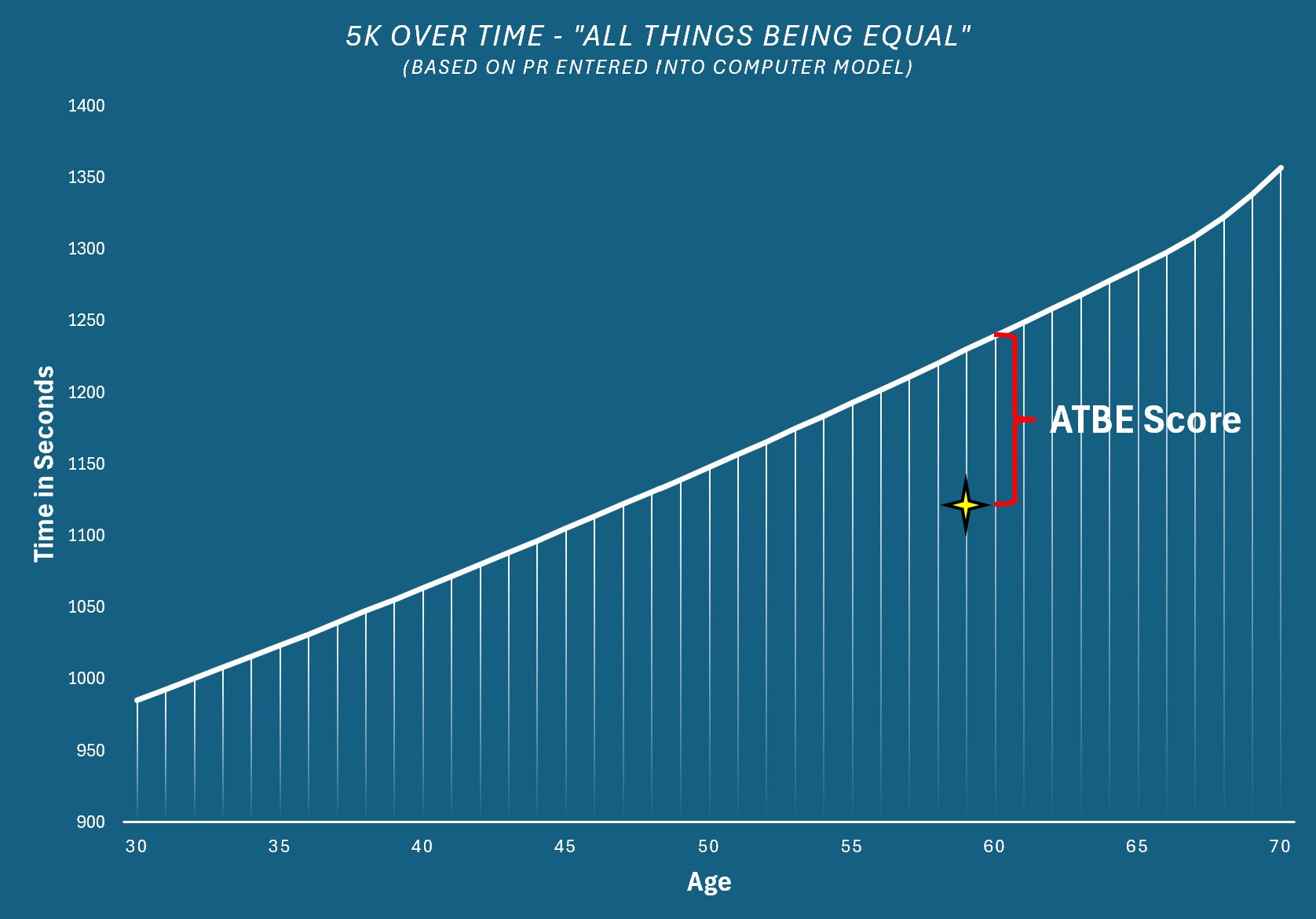
Using the chart provided by Dr. Fair’s computer model or plugging that data into a graph, I then compare my current 5K time (represented by the yellow star) to get my ATBE Score (the difference between where I’m expected to be based on all things being equal and my actual finish time). The further we can move below the line, the more we are integrating previously untapped components to perform better than our expected outcome.
Sure - it's easier to just keep doing what we've always done. It's part of life. Why not just go with the flow? What's the big deal about a functional and performance reduction of 1%/year for the rest of our lives? (tongue firmly in cheek just in case you can't see it). That is the way of the world - but it is not our way. We're NOT DONE YET! And now we have an objective way to demonstrate precisely that commitment, while adding another element of fun along the way.
Ray C. Fair, 2023. "Physical Decline Rates: Men versus Women," Cowles Foundation Discussion Papers 2371, Cowles Foundation for Research in Economics, Yale University.
I love this! It's given me a new outlook on running. My best record is 10K in 50 min at 25. I thought that was pretty metal. I'm 27 now, so I guess I could push myself harder.
Wow. This is got at a point on my mind when I woke up this morning. Great piece. Thank you for the tool and the gasoline.